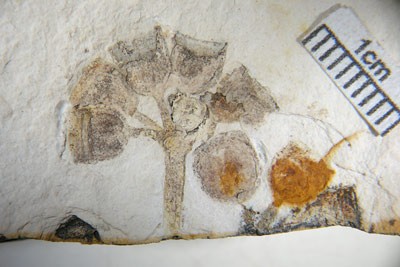
Fossil of Eucalyptus infructescence (group of fruits).
Fossils of leaves, flowers, fruits and buds found in Patagonia, Argentina, have been identified as Eucalyptus and date to 51.9 million years ago, making them the oldest scientifically validated Eucalyptus macrofossils and the only ones conclusively identified as naturally occurring outside of Australasia. A Cornell-led team of researchers, reporting in the June 28 issue of the online journal Public Library of Science One, identified the fossils as belonging to a Eucalyptus subgenus, Symphyomyrtus , which also makes that subgenus older than previously thought. The researchers identified a suite of structures characteristic to the genus Eucalyptus in the morphology (shape) of imprints found in separate fossils. Some key characteristics included long, thin leaves with smooth edges, dots on the leaves that reveal oil glands, and scars on the fruits from where petals and sepals fall off. The evolutionary history of Eucalyptus and its relatives has been poorly documented from the fossil record. In the past, a few researchers have claimed to identify Eucalyptus fossils from South America, but those records failed to hold up to modern scientific examination. "The genus Eucalyptus is restricted to Australia and a few surrounding islands, and it is completely extinct in South America, which makes this discovery very significant not only for botanists and paleobotanists, but also for [its] biogeographical implications," said Maria A. Gandolfo, a senior research associate in the Department of Plant Biology and the paper's co-lead author.
TO READ THIS ARTICLE, CREATE YOUR ACCOUNT
And extend your reading, free of charge and with no commitment.