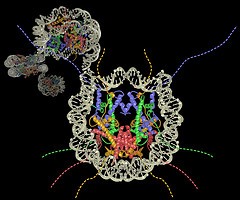
Credit: Karolin Luger DNA wraps an assembly of special proteins called histones (colored) to form the nucleosome, a structure responsible for regulating genes and for condensing DNA strands to fit into the cell's nucleus.
Scientists at Penn State have achieved a major milestone in the attempt to assemble, in a test tube, entire chromosomes from their component parts. The achievement reveals the process a cell uses to package the basic building blocks of an organism's entire genetic code - its genome. The evidence provided by early research with the new procedure overturns three previous theories of the genome-packaging process and opens the door to a new era of genome-wide biochemistry research. A paper describing the team's achievement will be published on May 20. The research was accomplished with the help of a new laboratory procedure developed by the team of scientists led by B. Franklin Pugh , the Willaman chair in molecular biology and a professor of biochemistry and molecular biology at Penn State. The procedure allows scientists, for the first time, to do highly controlled biochemical experiments with all the components of an organism's genome. The team's research is designed to reveal the construction process for the chromosome - the super-compressed marvel of molecular packaging that contains all an organism's DNA and associated proteins.
TO READ THIS ARTICLE, CREATE YOUR ACCOUNT
And extend your reading, free of charge and with no commitment.