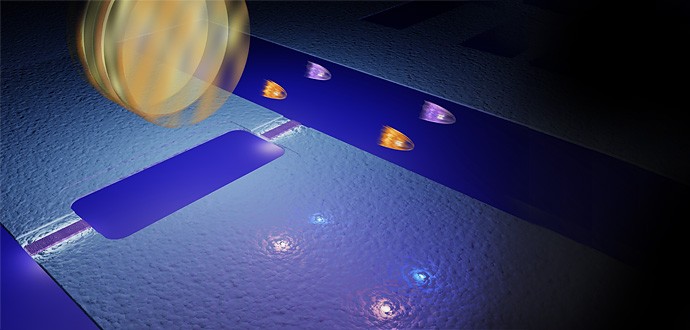
A team of physicists including a researcher from the University of Michigan observed what’s called the dynamical Casimir effect for the first time earlier this year. They essentially squeezed light particles from the vacuum of space. Image courtesy of Philip Krantz
ANN ARBOR, Mich.-They shook light from darkness. They coaxed something out of what we normally think of as nothing-the vacuum of space. And now their work has been named one of the top 10 breakthroughs of the year by Physics World, the international magazine announced today. University of Michigan physics researcher Franco Nori is involved in The physicists directly observed, for the first time, light particles that flicker in and out of existence in the vacuum. They witnessed the long-predicted quantum mechanical phenomenon known as the dynamical Casimir effect. "One of the profound consequences of quantum mechanics is that we know that something can come from nothing," Nori said. "The vacuum is actually teeming with activity, the question is how to harness it and observe it because the particles move in an out of existence in the blink of an eye." This background activity of fleeting particles is known as quantum vacuum fluctuations.
TO READ THIS ARTICLE, CREATE YOUR ACCOUNT
And extend your reading, free of charge and with no commitment.