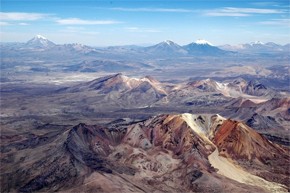
The Andes from the air. Photo by Pattron on Flickr.
A new study from The Australian National University has brought scientists a step closer to finding out how earthquakes happen. Giampiero Iaffaldano from the ANU Research School of Earth Sciences and colleagues in Italy and Germany used simple but innovative laboratory models to examine the forces behind the movement of plates in the Earth's thick outer shell. The team focused on the Nazca plate, which plunges beneath continental South America, because of its unusual curvature that is visible in the shape of the Andes. They found that a significant amount of force needed to be traded between the two plates to create the unique shape. Iaffaldano said this finding could help unravel the impact of plate interactions on large earthquakes. "The lithospheric plates that make up the Earth's outer shell move at a speed comparable to the growth of human nails," he said. "But while their motions are well known from observations of the ocean floors, we still lack a detailed knowledge of the forces that plates trade with each other.
TO READ THIS ARTICLE, CREATE YOUR ACCOUNT
And extend your reading, free of charge and with no commitment.