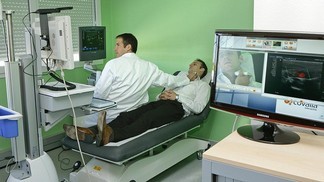
An ultrasound machine has been transformed into a telediagnosis tool. Specialists in other hospitals can see images in real time, pinpoint the exact zone they're coming from, and interact. Making a diagnosis using ultrasound images often requires advice from experts in other hospitals, particularly in neurology. Sonography is one of the most commonly used imaging techniques. But to make an interpretation, a doctor must have access to the ultrasound images and know exactly where the transducer is placed on the patient. This has been an obstacle to remote diagnostics, one that will soon be overcome. A remote ultrasound machine, developed by French-Swiss teams of researchers and two start-up companies, allows the specialist see the image taken by the transducer as well as its position, all in real time. The doctor can also indicate the exact area that he or she would like to see with the cursor. The technician who is with the patient then moves the transducer. This equipment has been adapted to work on traditional ultrasound machines. A small motion detector the size of a cherry is attached underneath the transducer. A optical feedback system consisting of two infrared cameras films the transducer, and a software program displays it in color on a virtual human on the screen. The corresponding ultrasound images are displayed in parallel. The specialist can thus interact with the image and ask the on-site team to move the transducer to precise points. The specialist indicates the zone to observe on the patient with a movement of the mouse. Already tested at the Lausanne University Hospital (CHUV) and the CHU in Besançon, the device will be commercially available within a few months. A server for medical imaging analysis
TO READ THIS ARTICLE, CREATE YOUR ACCOUNT
And extend your reading, free of charge and with no commitment.
Your Benefits
- Access to all content
- Receive newsmails for news and jobs
- Post ads