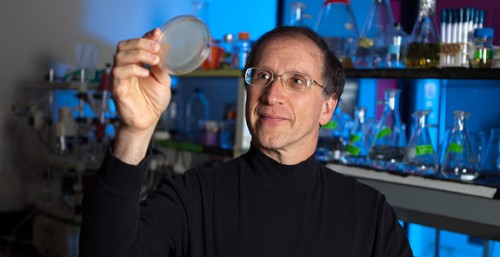
Michael Hecht, a professor of chemistry at Princeton University, has led a team of researchers who have for the first time constructed artificial proteins that enable the growth of living cells. The synthetic proteins were designed from scratch and expressed from artificial genes. He is holding samples of living bacteria containing the synthetic proteins. (Photo by Brian Wilson)
In a groundbreaking achievement that could help scientists "build" new biological systems, Princeton University scientists have constructed for the first time artificial proteins that enable the growth of living cells. The team of researchers created genetic sequences never before seen in nature, and the scientists showed that they can produce substances that sustain life in cells almost as readily as proteins produced by nature's own toolkit. "What we have here are molecular machines that function quite well within a living organism even though they were designed from scratch and expressed from artificial genes," said Michael Hecht , a professor of chemistry at Princeton, who led the research. "This tells us that the molecular parts kit for life need not be limited to parts - genes and proteins - that already exist in nature." The work, Hecht said, represents a significant advance in synthetic biology, an emerging area of research in which scientists work to design and fabricate biological components and systems that do not already exist in the natural world. One of the field's goals is to develop an entirely artificial genome composed of unique patterns of chemicals. "Our work suggests," Hecht said, "that the construction of artificial genomes capable of sustaining cell life may be within reach." Nearly all previous work in synthetic biology has focused on reorganizing parts drawn from natural organisms. In contrast, Hecht said, the results described by the team show that biological functions can be provided by macromolecules that were not borrowed from nature, but designed in the laboratory.
TO READ THIS ARTICLE, CREATE YOUR ACCOUNT
And extend your reading, free of charge and with no commitment.