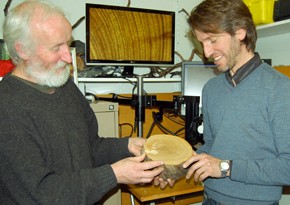
McDougall and Brookhouse examine the growth rings of a mountain plum pine.
In an Australian first, scientists have uncovered a new way of identifying 300 years of climatic changes in the Australian Alps by looking at the growth rings of a sturdy, long-lived alpine shrub. Mountain plum pine is found in the incredibly harsh and constantly cool Australian Alps where annual growth is very slow at less than 1 millimetre in diameter. Matthew Brookhouse from ANU said the 2003 bushfires led to the investigation into the native shrub, which can live for up to 600 years. "Prior to the devastating fires, most mountain plum pines were so old that the idea of cutting them up for analysis was not even considered. But the fires killed many plants that were centuries old and we found that they only regenerated from seed in the soil," he said. "With large numbers of dead plum pines available, we gathered cross sections and discovered that the growth rings could be used to reconstruct past climate, even though Australian plants had long been thought to be poor for this purpose. "We cross referenced rings from Mt Blue Cow in Kosciuszko National Park samples and found that in years with a lot of snow, the plants had narrow growth rings, so growth was directly related to temperature in the growing season." A narrow series of rings in all samples in the 1950s and 1960s reveal big snow years, especially in 1960, and in 1923, which was probably the biggest snow year of the 20th Century.
TO READ THIS ARTICLE, CREATE YOUR ACCOUNT
And extend your reading, free of charge and with no commitment.