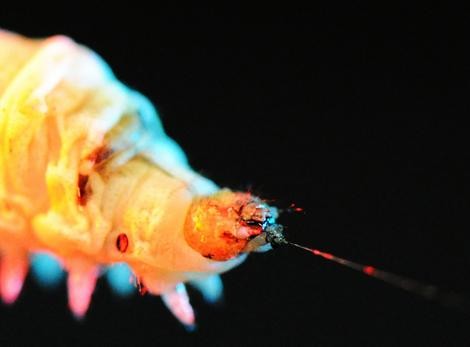
The Chinese silkworm spinning silk. Photo: OSG
Scientists at Oxford University and The University of Sheffield have demonstrated that natural silks are a thousand times more efficient than common plastics when it comes to forming fibres. A report of the research is published this week in the journal Advanced Materials . The finding comes from comparing silk from the Chinese silkworm ( Bombyx mori ) to molten high density polyethylene (HDPE) - a material from which the strongest synthetic fibres are made. The researchers used polarised light shining through a disk rotating over a plate to study the how fibres are formed as the two materials are spun. HDPE forms filaments at over 125°C and in addition requires substantial energy input in the form of "shear force" applied to the material in its molten form. Silks, in contrast, in the same set-up forms filaments at ambient temperature and in addition requires only a tenth of the shear force. If the energetic costs of melting HDPE are included for comparison, silks become a thousand times more efficient.
TO READ THIS ARTICLE, CREATE YOUR ACCOUNT
And extend your reading, free of charge and with no commitment.