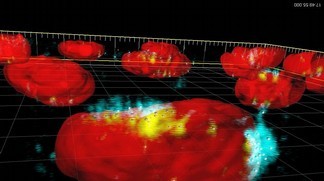
 Superparamagnetic iron oxide particles (blue and yellow) absorbed in a nucleus of a cell (nucleus in red).
Detecting cancer cells and destroying them, injecting drugs with extreme precision into diseased cells in the human body - these are just two examples of what scientists are attempting to accomplish using iron oxide nanoparticles. Just 5 - 10 nanometers in diameter (a nanometer is one millionth of a millimeter), the superparamagnetic iron oxide nanoparticles being studied by Heinrich Hofmann and his team are promising, because they exhibit magnetic properties when exposed to an external magnetic field. That characteristic is important for certain medical applications, such as diagnosing diseases such as arthritis, locating tumors, and destroying cancer cells in patients. Detecting cancer - The EPFL scientists are looking at three main applications: diagnostics, treatment and elimination of malignant cells. "In practice, iron oxide particles are already used as contrast agents in Magnetic Resonance Imaging (MRI) in liver tumor cases," notes Hofmann. "We are studying how to apply this method to all kinds of tumors and if possible to other diseases, like Arthritis. The latter is the goal of a large EU FP-7 project ( Nanodiara )." This is how it works: cancer cells have receptors on their surface, a sort of cellular ID.
TO READ THIS ARTICLE, CREATE YOUR ACCOUNT
And extend your reading, free of charge and with no commitment.
Your Benefits
- Access to all content
- Receive newsmails for news and jobs
- Post ads