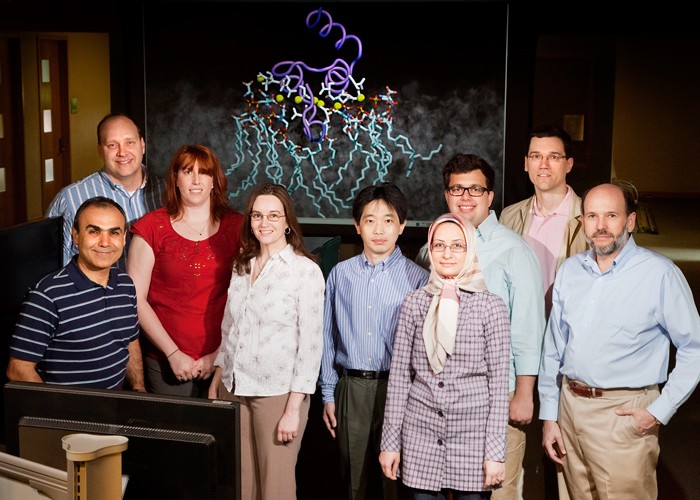
An interdisciplinary collaboration at the University of Illinois led to a breakthrough in understanding blood clotting. Researchers on the study were (from left): Emad Tajkhorshid, Chad Rienstra, Mary Clay, Rebecca Davis-Harrison, Zenmei Ohkubo, Narjes Tavoosi, Mark Arcario, Taras Pogorelov and James Morrissey.
CHAMPAIGN, lll. Blood clotting is a complicated business, particularly for those trying to understand how the body responds to injury. In a new study, researchers report that they are the first to describe in atomic detail a chemical interaction that is vital to blood clotting. This interaction - between a clotting factor and a cell membrane - has baffled scientists for decades. The study appears online in the Journal of Biological Chemistry. "For decades, people have known that blood-clotting proteins have to bind to a cell membrane in order for the clotting reaction to happen," said University of Illinois biochemistry professor James Morrissey, who led the study with chemistry professor Chad Rienstra and biochemistry, biophysics and pharmacology professor Emad Tajkhorshid. "If you take clotting factors off the membrane, they're thousands of times less active." The researchers combined laboratory detective work with supercomputer simulations and solid-state nuclear magnetic resonance (SSNMR) to get at the problem from every angle.
TO READ THIS ARTICLE, CREATE YOUR ACCOUNT
And extend your reading, free of charge and with no commitment.