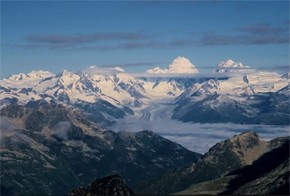
The Himalayas. Photo by Dru! on Flickr
New research from The Australian National University, the University of Kashmir and the University of Delhi has provided evidence that disputes the widely accepted theory of how India and Eurasia came together. Lloyd White from the Research School of Earth Sciences said the team used the ANU-designed Sensitive High Resolution Ion Microprobe (SHRIMP) to date zircon crystals from north of the ancient plate boundary between India and Eurasia, and found they were the same age as those from the south. "Many scientists envisage the India-Eurasia collision as a relatively simple system where two continental plates rammed into each other," he said. "Our research findings show that it was a bit more complicated than that. We don't really know where to draw a line on the map that defines which bit was India and which bit was Eurasia, and we don't know if material was transferred from one plate to another. "As Gondwana broke-apart, new volcanic islands and relatively small tectonic plates were created between India and Eurasia. What we now think is that these islands and small plates got sandwiched between India and Eurasia as they crashed together.
TO READ THIS ARTICLE, CREATE YOUR ACCOUNT
And extend your reading, free of charge and with no commitment.