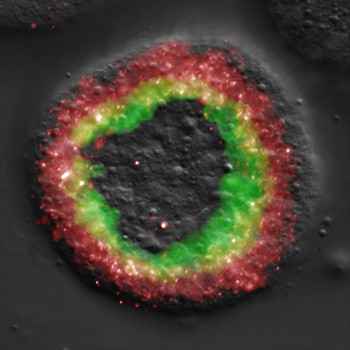
This image of a sea-urchin embryo shows where two different regulatory genes are being expressed, labeled in fluorescent green and red.
Caltech biologists create the first predictive computational model of gene networks that control the development of sea-urchin embryos. As an animal develops from an embryo, its cells take diverse paths, eventually forming different body parts—muscles, bones, heart. In order for each cell to know what to do during development, it follows a genetic blueprint, which consists of complex webs of interacting genes called gene regulatory networks. Biologists at the California Institute of Technology (Caltech) have spent the last decade or so detailing how these gene networks control development in sea-urchin embryos. Now, for the first time, they have built a computational model of one of these networks. This model, the scientists say, does a remarkably good job of calculating what these networks do to control the fates of different cells in the early stages of sea-urchin development—confirming that the interactions among a few dozen genes suffice to tell an embryo how to start the development of different body parts in their respective spatial locations. The model is also a powerful tool for understanding gene regulatory networks in a way not previously possible, allowing scientists to better study the genetic bases of both development and evolution.
TO READ THIS ARTICLE, CREATE YOUR ACCOUNT
And extend your reading, free of charge and with no commitment.