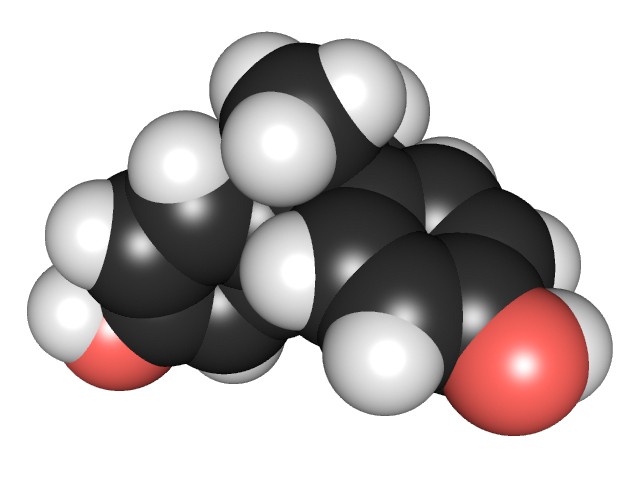
3D chemical structure of bisphenol A. Image courtesy of Edgar181 via Wikimedia Commons
ANN ARBOR-New research from the University of Michigan School of Public Health found BPA, or bisphenol A, in fetal liver tissue, demonstrating that there is considerable exposure to the chemical during pregnancy. Researchers also found a proportionately higher concentration of free BPA-as opposed to the conjugated forms modified by the body for elimination-further showing that in fetuses the ability to eliminate the chemical from the body is not the same as in adults. "The general message from our research is that people have to be cognizant of the fact that the adult body may be able to deal with a particular exposure but a developing fetus may not," said Muna Nahar, doctoral student in the School of Public Health's Department of Environmental Health Sciences and first author on the paper. Previous animal studies have associated BPA with breast and prostate cancer, and reproductive and behavioral abnormalities. Some research on effects to human health has tied BPA to cardiovascular disease, miscarriage, decreased semen quality and childhood behavioral issues. The chemical also may impact metabolism, diabetes and obesity, although more studies are required to determine its effects. Prior research on BPA-a chemical used in many consumer products, including plastic bottles and metal food and beverage cans-has measured concentrations of the chemical in urine.
TO READ THIS ARTICLE, CREATE YOUR ACCOUNT
And extend your reading, free of charge and with no commitment.