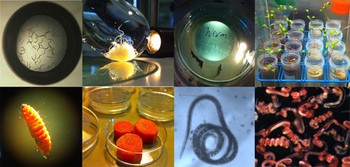
Many different species of nematodes were found by the Sternberg lab to communicate using the same types of chemical cues.
All animals seem to have ways of exchanging information—monkeys vocalize complex messages, ants create scent trails to food, and fireflies light up their bellies to attract mates. Yet, despite the fact that nematodes, or roundworms, are among the most abundant animals on the planet, little is known about the way they network. Now, research led by California Institute of Technology (Caltech) biologists has shown that a wide range of nematodes communicate using a recently discovered class of chemical cues. A paper outlining their studies—which were a collaborative effort with the laboratory of Frank C. Schroeder, assistant scientist at the Boyce Thompson Institute for Plant Research (BTI) of Cornell University—was published online April 12 in the journal Current Biology . Previous research by several members of this team had recently shown that a much-studied nematode, Caenorhabditis elegans , uses certain chemical signals to trade data. What was unknown was whether other worms of the same phylum "talk" to one another in similar ways. But when the researchers looked at a variety of nematodes, they found the very same types of chemicals being combined and used for communication, says Paul Sternberg, the Thomas Hunt Morgan Professor of Biology at Caltech and senior author on the study.
TO READ THIS ARTICLE, CREATE YOUR ACCOUNT
And extend your reading, free of charge and with no commitment.