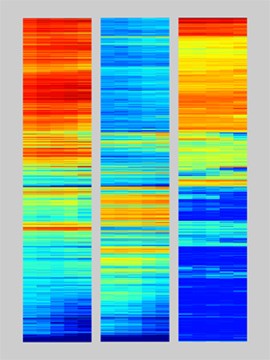
These bars summarize the epigenetic markers correlated with RNA-expression levels for each of about 20,800 known genes in the mouse genome. The left column shows epigenetic markers correlated with activation, the middle shows repression markers, and the right shows the RNA levels expressed by the corresponding genes. Reading across each row, genes that change expression or epigenetic markers during T-cell development change color.
What happens to a stem cell at the molecular level that causes it to become one type of cell rather than another? At what point is it committed to that cell fate, and how does it become committed? The answers to these questions have been largely unknown. But now, in studies that mark a major step forward in our understanding of stem cells' fates, a team of researchers from the California Institute of Technology (Caltech) has traced the stepwise developmental process that ensures certain stem cells will become'T cells—cells of the immune system that help destroy invading pathogens. "This is the first time that a natural developmental process has been dissected in such detail, going from step to step to step, looking at activities of all the genes in the genome," says Ellen Rothenberg, the principal investigator on the study and Albert Billings Ruddock Professor of Biology at Caltech. "It means that in genetic terms, there is virtually nothing left hidden in this system." The study was led by Jingli A. Zhang, a graduate student in Rothenberg's lab, who is now a postdoctoral scholar at Caltech. The group's findings appear in the April 13 issue of the journal Cell . The researchers studied multipotent hematopoietic precursor cells—stem-cell-like cells that express a wide variety of genes and have the capability to differentiate into a number of different blood-cell types, including those of the immune system. Taking into consideration the entire mouse genome, the researchers pinpointed all the genes that play a role in transforming such precursor cells into committed'T cells and identified when in the developmental process they each turn on.
TO READ THIS ARTICLE, CREATE YOUR ACCOUNT
And extend your reading, free of charge and with no commitment.