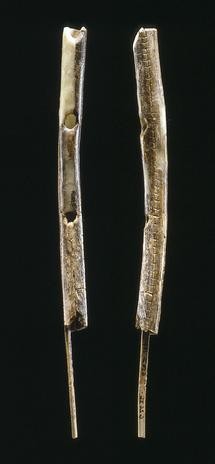
A flute from the site of Geißenklösterle made from mammoth ivory.
The first modern humans in Europe were playing musical instruments and showing artistic creativity as early as 40,000 years ago, according to new research from Oxford and Tübingen universities. The researchers have obtained important new radiocarbon dates for bones found in the same archaeological layers as a variety of musical instruments. The instruments take the form of flutes made from the bird bones and mammoth ivory. They were excavated at a key site in Germany, which is widely believed to have been occupied by some of first modern humans to arrive in Europe. In a paper published in the Journal of Human Evolution , the researchers describe the new dating results for animal bones, excavated in the same archaeological layers as the instruments and early art, at Geißenklösterle Cave in the Swabian Jura of southern Germany. The animal bones bear cuts and marks from human hunting and eating. The new dates were obtained by Professor Tom Higham and his team at Oxford University, using an improved ultrafiltration method designed to remove contamination from the collagen preserved in the bones.
TO READ THIS ARTICLE, CREATE YOUR ACCOUNT
And extend your reading, free of charge and with no commitment.