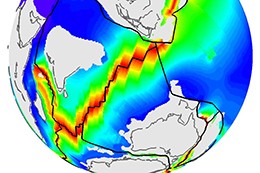
Picture showing the mid-oceanic ridges in the South Pacific, Indian and Atlantic Oceans.
The mystery of erratic changes in the history of Earth's past and current plate motions has been cracked by academics from The Australian National University. Giampiero Iaffaldano, from the Research School of Earth Sciences in the ANU College of Physical and Mathematical Sciences, led a team that found true changes in plate motions occur on timescales no shorter than a few million years. "The scenario arising from recent data was puzzling because plates appeared to move erratically and significantly over geologically-short periods of less than one million years," said Iaffaldano. "This posed a conundrum, as the forces that would be required to explain their sudden motions far exceed the most optimistic estimates we could make." Iaffaldano's research focused on the detailed records of plate motions across the mid-oceanic ridges in the South Pacific, Indian and Atlantic Oceans. After accounting for data noise - the portion of data that was unrelated to Earth's plate motions - he found that true changes in plate motions occur on timescales no shorter than five million years. "A major discovery of the study is that, upon noise reduction, true changes in plate motions occur on timescales no shorter than a few million years. This yields simpler movement patterns and more plausible dynamics," he said.
TO READ THIS ARTICLE, CREATE YOUR ACCOUNT
And extend your reading, free of charge and with no commitment.