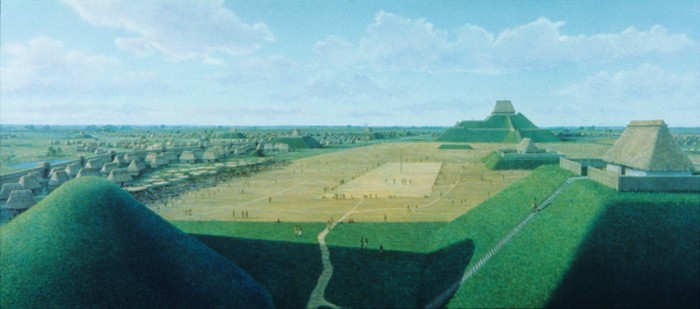
The pre-Columbian settlement at Cahokia was the largest city in North America north of Mexico, with as many as 50,000 people living there at its peak.
CHAMPAIGN, lll. People living 700 to 900 years ago in Cahokia, a massive settlement near the confluence of the Missouri and Mississippi Rivers, ritually used a caffeinated brew made from the leaves of a holly tree that grew hundreds of miles away, researchers report. The discovery - made by analyzing plant residues in pottery beakers from Cahokia and its surroundings - is the earliest known use of this "black drink" in North America. It pushes back the date by at least 500 years, and adds to the evidence that a broad cultural and trade network thrived in the Midwest and southeastern U.S. as early as A.D. The new findings 000 residents in its heyday, the largest prehistoric North American settlement north of Mexico. "This finding brings to us a whole wide spectrum of religious and symbolic behavior at Cahokia that we could only speculate about in the past," said Thomas Emerson , the director of the Illinois State Archaeological Survey and a collaborator on the study with researchers at the University of Illinois, the University of New Mexico, Millsaps College in Mississippi and Hershey Technical Center in Pennsylvania. The Archaeological Survey is part of the Prairie Research Institute at the U. of I. University of New Mexico anthropology professor Patricia Crown and Hershey Technical Center chemist Jeffrey Hurst conducted the chemical analyses of plant residues on the Cahokian beakers, a project inspired in part by a similar analysis they led that found that people living in Chaco Canyon, in present-day New Mexico, in A.D. 1100-1125 consumed liquid chocolate in special ceramic vessels found there.
TO READ THIS ARTICLE, CREATE YOUR ACCOUNT
And extend your reading, free of charge and with no commitment.