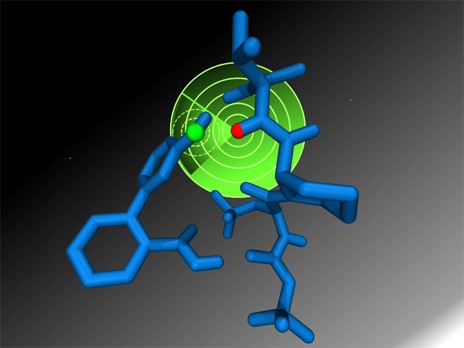
Researchers at Yale University have developed a new way of exposing the atomic attachments that keep complex molecules in precise alignment. The new method could provide insight into the mechanics of a variety of molecular structures, potentially aiding efforts to manipulate them for drug discovery and other purposes.
Researchers at Yale University have developed a new way of exposing the atomic attachments that keep complex molecules in precise alignment. The new method could provide insight into the mechanics of a variety of molecular structures, potentially aiding efforts to manipulate them for drug discovery and other purposes. "The method appears likely to become a central tool for the characterization of processes that depend on supramolecular associations," said Mark Johnson, a Yale chemistry professor and the principal investigator of the technique, which is described in a paper published this month . Supramolecular associations are interactions taking place between molecules, rather than within them. Yale has filed a patent application for the technique, which Johnson's team calls cryogenic infared spectroscopy. At core, the new method involves freezing non-covalently-bonded molecules in isolation to generate a molecular-level snapshot of exactly how they attach to each other. These are molecules bonded by relatively weak forces compared with other types of molecular attachments.
TO READ THIS ARTICLE, CREATE YOUR ACCOUNT
And extend your reading, free of charge and with no commitment.