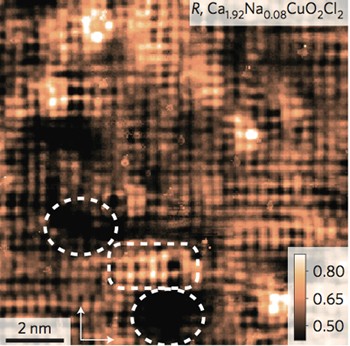
Scanning tunneling microscope image of a partially doped cuprate superconductor shows regions with an electronic "pseudogap" (rounded rectangle) others with no progress from the original insulator (dashed circles). As doping increases, pseudogap regions spread and connect, making the whole sample a superconductor.
High-temperature superconductivity doesn't happen all it once. It starts in isolated nanoscale patches that gradually expand until they take over. That discovery, from atomic-level observations at Cornell and the University of Tokyo, offers a new insight into the puzzling "pseudogap" state observed in high-temperature superconductors; it may be another step toward creating new materials that superconduct at temperatures high enough to revolutionize electrical engineering. Using extremely precise scanning tunneling microscopes (STM) that can observe the states of electrons around atoms, an international research team led by J.C. Séamus Davis, the J.G. White Distinguished Professor in the Physical Sciences, and by Hidenori Takagi, professor of physics at the University of Tokyo, has for the first time observed how a high-temperature superconductor evolves as its chemical composition is modified. They found that as more "dopant" atoms are added, small, scattered superconducting areas, some just a few atoms across, appear. These grow until they touch and eventually fill the entire space, whereupon the entire material becomes a superconductor. "Some theorists have imagined that this is what happens," Davis said, "but there has been no evidence until now." The research was reported May 20 in the online edition of.
TO READ THIS ARTICLE, CREATE YOUR ACCOUNT
And extend your reading, free of charge and with no commitment.