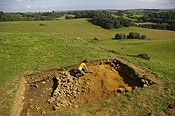
Excavations underway at Ham Hill
Excavations at Britain's largest prehistoric hillfort have given archaeologists from Cardiff and Cambridge universities a glimpse of what life was like inside the fort more than 2000 years ago. Niall Sharples of Cardiff's School of History, Archaeology and Religion and Chris Evans of Cambridge's Archaeological Unit are jointly leading a team excavating Ham Hill in Somerset. Stretching across more than 80 hectares, Ham Hill is one of Britain's nationally significant sites, yet little is known about its meaning or purpose. In a three-year project, Cardiff and Cambridge archaeologists are undertaking the most intensive excavation of the site to date, aiming to transform our understanding of the fort. The 2012 excavations targeted the ramparts that surround and define the hillfort - one on the southern side, and two on the northern edge. Speaking about the investigation of the ramparts, Niall Sharples of Cardiff University said: "Our excavations have revealed particularly well preserved occupation deposits in the area immediately behind the ramparts. In the south an Iron Age house was built in the back of the rampart.
TO READ THIS ARTICLE, CREATE YOUR ACCOUNT
And extend your reading, free of charge and with no commitment.