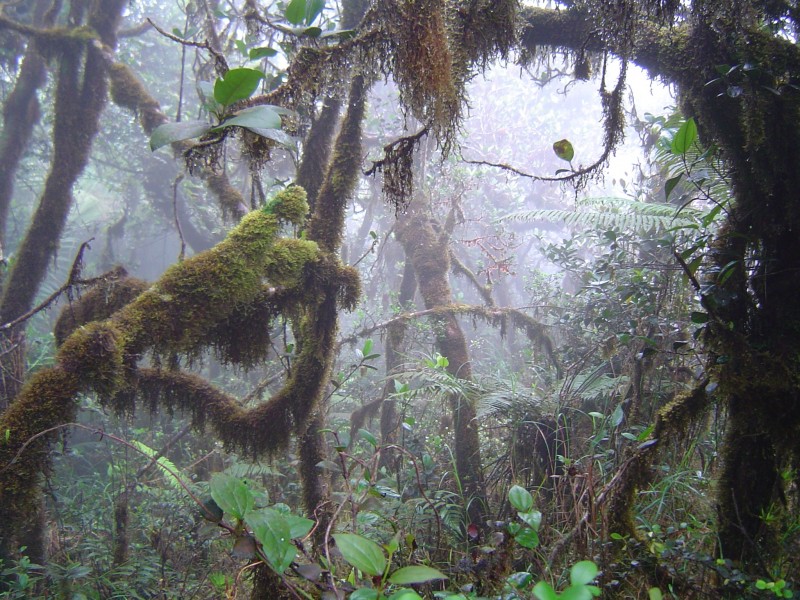
The El Yunque National Forest in Puerto Rico is a tropical rain forest where a strain of the microbe Enterobacter lignolyticus was found that can tolerate an ionic liquid used to dissolve cellulosic biomass for microbial-based biofuel production. (Photo by Kristen DeAngelis)
In the search for technology by which economically competitive biofuels can be produced from cellulosic biomass, the combination of sugar-fermenting microbes and ionic liquid solvents looks to be a winner save for one major problem: the ionic liquids used to make cellulosic biomass more digestible for microbes can also be toxic to them. A solution to this conundrum, however, may be in the offing. Researchers with the U.S. Department of Energy (DOE)'s Joint BioEnergy Institute (JBEI), a multi-institutional partnership led by Berkeley Lab, have identified a tropical rainforest microbe that can endure relatively high concentrations of an ionic liquid used to dissolve cellulosic biomass. The researchers have also determined how the microbe is able to do this, a discovery that holds broad implications beyond the production of advanced biofuels. "Our findings represent an important first step in understanding the mechanisms of ionic liquid resistance in bacteria and provide a basis for engineering ionic liquid tolerance into strains of fuel-producing microbes for a more efficient biofuel production process," says Blake Simmons, a chemical engineer who heads JBEI's Deconstruction Division and one of the senior investigators for this research. Adds Michael Thelen, the principal investigator and a member of JBEI's Deconstruction Division, "Our study also demonstrates that vigorous efforts to discover and analyze the unique properties of microorganisms can provide an important basis for understanding microbial stress and adaptation responses to anthropogenic chemicals used in industry." Thelen is the corresponding author and Simmons a co-author of a paper reporting the results of this research in the Proceedings of the National Academy of Sciences ( PNAS ).
TO READ THIS ARTICLE, CREATE YOUR ACCOUNT
And extend your reading, free of charge and with no commitment.