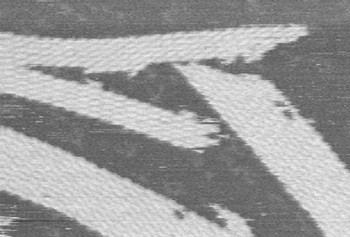
DNA tile ribbons (shown here in an atomic force microscopy image) can store information in their arrangement of tiles—12.5nm x 4nm x 2nm self-assembled DNA structures. This information can be propagated during ribbon growth, and replicated in a cycle of ribbon growth and breakage, or scission.
When scientists think about the replication of information in chemistry, they usually have in mind something akin to what happens in living organisms when DNA gets copied: a double-stranded molecule that contains sequence information makes two new copies of the molecule. But researchers at the California Institute of Technology (Caltech) have now shown that a different mechanism can also be used to copy sequence information. In this alternate version, tiny DNA tile crystals consisting of many copies of a piece of information are first grown, then broken into a few pieces by mechanically-induced scission, or force. The new crystal bits contain all the information needed to keep copying the sequence. Each piece then begins to replicate its information and grow until broken apart again—without the help of enzymes, an essential ingredient in biological sequence replication. In some ways, the new system is reminiscent of Goethe's poem, The Sorcerer's Apprentice , in which the apprentice smashes a magic mop with an axe, producing many exact replicas of the sweeper, all programmed to do the same job. "The genome-copying mechanism used by cells requires tight control between the separation of DNA strands and the copying process," explains study lead author Rebecca Schulman, an assistant professor at Johns Hopkins University who was a graduate student at Caltech when the research began.
TO READ THIS ARTICLE, CREATE YOUR ACCOUNT
And extend your reading, free of charge and with no commitment.