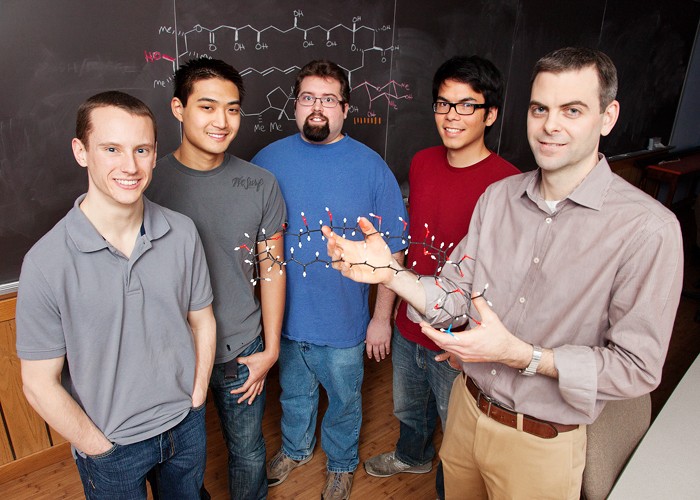
Illinois chemists discovered that a powerful treatment for fungal infections doesn’t work the way doctors have assumed, setting a new course for drug development. The researchers, led by chemistry Martin Burke, right, are, from left, graduate students Ian Dailey, Matthew Endo, Brandon Wilcock, Brice Uno and, not pictured, Kaitlyn Gray and Daniel Palacios.
CHAMPAIGN, Ill. With one simple experiment, University of Illinois chemists have debunked a widely held misconception about an often-prescribed drug. Led by chemistry professor and Howard Hughes Medical Institute early career scientist Martin Burke, the researchers demonstrated that the top drug for treating systemic fungal infections works by simply binding to a lipid molecule essential to yeast's physiology, a finding that could change the direction of drug development endeavors and could lead to better treatment not only for microbial infections but also for diseases caused by ion channel deficiencies. "Dr. Burke's elegant approach to synthesizing amphotericin B, which has been used extensively as an antifungal for more than 50 years, has now allowed him to expose its elusive mode of action," said Miles Fabian, who oversees medicinal chemistry research grants at the National Institute of General Medical Sciences. The institute is part of the National Institutes of Health, which supported the work. "This work opens up avenues for improving upon current antifungals and developing novel approaches for the discovery of new agents." Systemic fungal infections are a problem worldwide and affect patients whose immune systems have been compromised, such as the elderly, patients treated with chemotherapy or dialysis, and those with HIV or other immune disorders. A drug called amphotericin (pronounced AM-foe-TARE-uh-sin) has been medicine's best defense against fungal infections since its discovery in the 1950s. It effectively kills a broad spectrum of pathogenic fungi and yeast, and has eluded the resistance that has dogged other antibiotics despite its long history of use. The downside?
TO READ THIS ARTICLE, CREATE YOUR ACCOUNT
And extend your reading, free of charge and with no commitment.