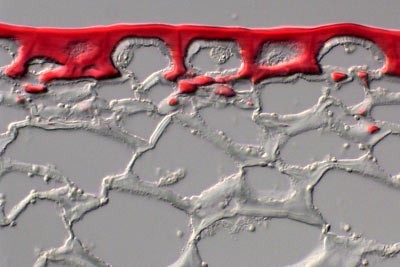
Light microscopy image of tomato fruit cuticle stained in red.
For the first time, scientists have identified how a plant's skin is assembled. All plants have a skin, called a cuticle, that covers the above-ground surfaces. It is composed of waxes and a polymer network - a large molecule made of fatty acid building blocks called cutin that are bonded together. The findings, published online May 21 and to appear in the July , have important agricultural implications, since understanding the basic biology of plant skins opens the door for researchers to develop therapies to prevent plant diseases and other cuticle-related conditions in the future. Plant skins are essential to prevent leaves, stems, flowers and fruits from drying out, provide a barrier against pathogens, protect against ultraviolet radiation and prevent organs from fusing together during development. The waxy coating is also responsible for the "lotus effect" that causes water to bead off a plant's surface, taking dust and microbial spores with it. "How these building blocks of cutin get put together has been completely unknown," said Jocelyn Rose, associate professor of plant biology and the paper's senior author.
TO READ THIS ARTICLE, CREATE YOUR ACCOUNT
And extend your reading, free of charge and with no commitment.