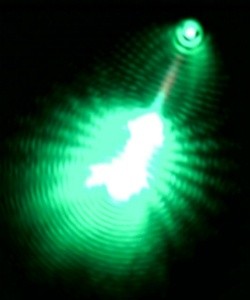
Laser light is emitted from the end of a cadmium sulfide nanowire.
Computers may be getting faster every year, but those advances in computer speed could be dwarfed if their 1's and 0's were represented by bursts of light, instead of electricity. Researchers at the University of Pennsylvania have made an important advance in this frontier of photonics, fashioning the first all-optical photonic switch out of cadmium sulfide nanowires. Moreover, they combined these photonic switches into a logic gate, a fundamental component of computer chips that process information. The research was conducted by associate professor Ritesh Agarwal and graduate student Brian Piccione of the Department of Materials Science and Engineering in Penn's School of Engineering and Applied Science. Post-doctoral fellows Chang-Hee Cho and Lambert van Vugt, also of the Materials Science Department, contributed to the study. It was published Nanotechnology. The research team's innovation built upon their earlier research, which showed that their cadmium sulfide nanowires exhibited extremely strong light-matter coupling , making them especially efficient at manipulating light.
TO READ THIS ARTICLE, CREATE YOUR ACCOUNT
And extend your reading, free of charge and with no commitment.