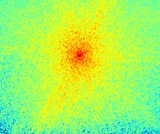
The image before it is reconstructed using a computer
Scientists revolutionise electron microscope. Researchers at the University of Sheffield have revolutionised the electron microscope by developing a new method which could create the highest resolution images ever seen. For over 70 years, transmission electron microscopy (TEM), which `looks through´ an object to see atomic features within it, has been constrained by the relatively poor lenses which are used to form the image. The new method, called electron ptychography, dispenses with the lens and instead forms the image by reconstructing the scattered electron-waves after they have passed through the sample using computers. Scientists involved in the scheme consider their findings to be a `first step´ in a `completely new epoch of electron imaging´. The process has no fundamental experimental boundaries and it is thought it will transform sub-atomic scale transmission imaging. Project leader Professor John Rodenburg, of the University of Sheffield´s Department of Electronic and Electrical Engineering, said: "To understand how material behaves, we need to know exactly where the atoms are.
TO READ THIS ARTICLE, CREATE YOUR ACCOUNT
And extend your reading, free of charge and with no commitment.