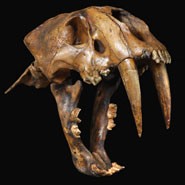
Our results show that differences in cat skull shape have deeply rooted evolutionary histories, first between the sabre-toothed and conical-toothed cats, and then between small-medium and large cats.
Modern cats diverged in skull shape from their sabre-toothed ancestors early in their evolutionary history and then followed separate evolutionary trajectories, according to new research from the University of Bristol published today in PLoS ONE. The study also found that the separation between modern domestic cats and big cats such as lions and tigers is also deeply rooted. Manabu Sakamoto and Marcello Ruta in the School of Earth Sciences studied the skull shape of extinct sabre-toothed cats, modern (conical-toothed) cats and prehistoric 'basal' cats (ancestors of modern cats). This is the first time these three different types of cats have been analysed together in a single dataset. The researchers quantified skull shape by taking various measurements, adjusting these measurements for size differences, then investigating the distribution of cat skulls in shape-space. By estimating ancestral positions through shape-space and time, they investigated patterns of skull shape evolution across the cat family tree. They found an early and conspicuous divergence between the conical-toothed cats and sabre-toothed cats, with all sabre-toothed cats being more closely related to each other than they were to modern conical-toothed cats.
TO READ THIS ARTICLE, CREATE YOUR ACCOUNT
And extend your reading, free of charge and with no commitment.