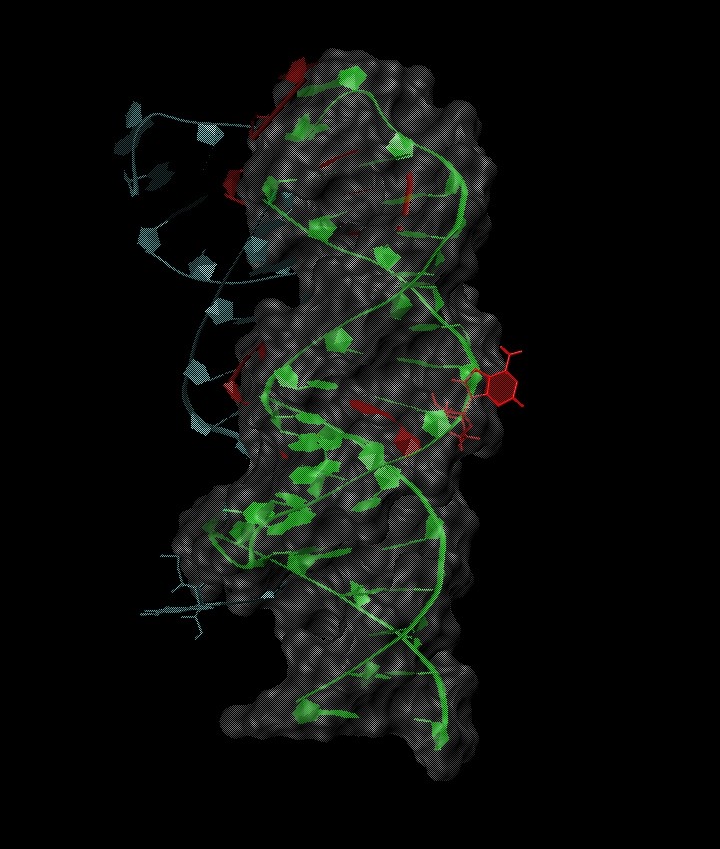
Image courtesy of Hashim Al-Hashimi
ANN ARBOR, Mich.-A University of Michigan biophysical chemist and his colleagues have discovered the smallest and fastest-known molecular switches made of RNA, the chemical cousin of DNA. The researchers say these rare, fleeting structures are prime targets for the development of new antiviral and antibiotic drugs. Once believed to merely store and relay genetic information, RNA is now known to be a cellular Swiss Army knife of sorts, performing a wide variety of tasks and morphing into myriad shapes. Over the past decade, researchers have determined that most of the DNA in our cells is used to make RNA molecules, that RNA plays a central role in regulating gene expression, and that these macromolecules act as switches that detect cellular signals and then change shape to send an appropriate response to other biomolecules in the cell. While RNA's switching function has been well-documented, Hashim Al-Hashimi and his U-M colleagues report online Oct. 7 a new class of switches that are significantly smaller and orders of magnitude faster than the other known class of RNA switches. Al-Hashimi calls these short-lived structures, which were detected using a new imaging technique developed in his laboratory, micro-switches.
TO READ THIS ARTICLE, CREATE YOUR ACCOUNT
And extend your reading, free of charge and with no commitment.