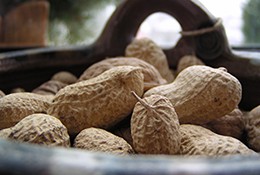
An increasing number of studies have implicated breast feeding as a cause of the increasing trend in nut allergy. Photo by random_alias on Flickr.
Children who are solely breast fed in the first six months of life are at an increased risk of developing a nut allergy, research from The Australian National University has found. A joint research project between the ANU Medical School, part of the ANU College of Medicine, Biology and Environment, and the ACT Health Directorate, investigated a link between breast feeding and nut allergies using the ACT Kindergarten Health Check Questionnaire given to the parents of children starting primary school in the Territory. Parents were asked to report if the child had a nut allergy, and on feeding habits in the first six months of life. The study found that rates of nut allergies in ACT children are increasing and children who were breast fed were more likely to have a nut allergy. "Some 3.9 per cent of children starting school in the ACT have a parent-reported nut allergy, which is almost twice the rate of British children of the same age," said the study's author and Professor of General Practice at the ANU Medical School, Marjan Kljakovic. The likelihood of developing a nut allergy was 1.5 times higher in children who were solely breast fed in the first six months of life, than in children who were exposed to other foods and fluids. Protection against nut allergy was found in children who were fed food and fluids other than breast milk.
TO READ THIS ARTICLE, CREATE YOUR ACCOUNT
And extend your reading, free of charge and with no commitment.