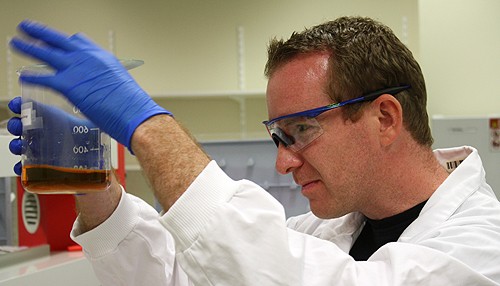
Dr Nial Wheate: "This discovery means we can potentially direct where in the body a drug goes."
For more than three decades scientists have been investigating magnetic nanoparticles as a method of drug delivery. Now by combining three metals - iron, gold and platinum - pharmacists at the University of Sydney believe they have discovered a method for magnetically directing drugs through the body. The discovery has been published online today in the international journal Inorganica Chimica Acta . Led by Nial Wheate , a team of scientists from the Faculty of Pharmacy , along with collaborators in Scotland, have developed a new anticancer drug that has an iron oxide core as small as 5 nanometres in size (1/1000th the width of a human hair). "We coated this iron oxide core in a protective layer of gold before cisplatin, a platinum drug that revolutionised the treatment of testicular cancer, was attached to the gold coating using spaghetti-like strings of polymer." The important thing about this new drug, says Wheate, is the ability of its iron core to move under the influence of a magnet; similar to the iron filing experiments many people have performed in science classes. "When we take regular medication it is difficult to manage where it goes. But this discovery means we can potentially direct exactly where in the human body a drug goes.
TO READ THIS ARTICLE, CREATE YOUR ACCOUNT
And extend your reading, free of charge and with no commitment.