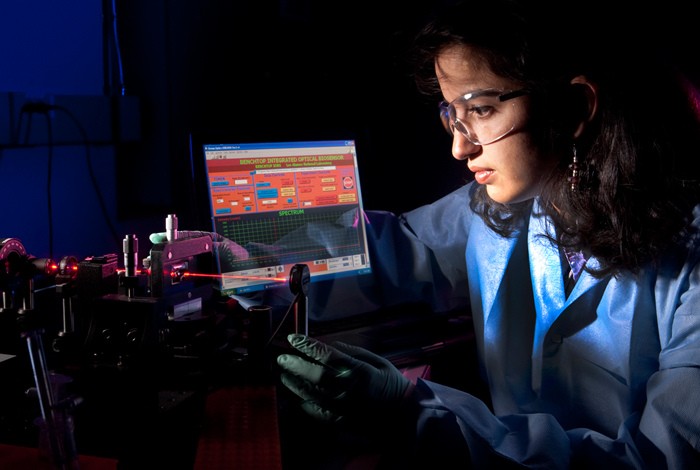
Los Alamos National Laboratory researcher Harshini Mukundan is exploring new ways to detect and diagnose tuberculosis.
LOS ALAMOS, N.M. April 19, 2013—New work from Los Alamos National Laboratory shows promise for stemming the advance of tuberculosis (TB) by revealing how the bacterium interacts with its human hosts and thus providing a new pathway for early detection in patients. A recent publication from the Los Alamos Biosensor Team describes the association of a key tuberculosis virulence factor, lipoarabinomannan (LAM) with human high-density lipoproteins (HDL) in blood. "Understanding the pathophysiology of tuberculosis, and the distribution of pathogen-associated molecules in the host, is essential to developing efficient methods of intervention,” said Harshini Mukundan, corresponding author on the paper. "Association of lipoarabinomannan with high density lipoprotein in blood: Implications for diagnostics” Tuberculosis 93 (2013) was published April 3rd, 2013, in the journal Tuberculosis. The team's efforts have focused on using the LAM virulence factor as a sensitive indicator for TB. The problem has been that the biomarker, while being a reliable early indicator of TB, is very difficult to detect, especially in blood. Previously, the team has developed strategies for the detection of this biomarker in urine (Mukundan H et al, Tuberculosis, June 2012).
TO READ THIS ARTICLE, CREATE YOUR ACCOUNT
And extend your reading, free of charge and with no commitment.