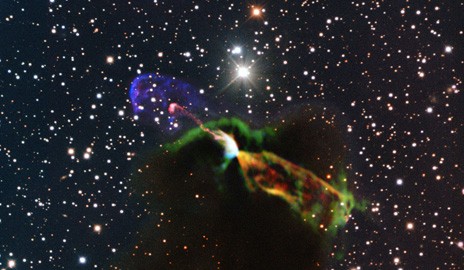
Star formation is an even more intense and dynamic process than previously thought, according to research led by Yale astronomer Héctor Arce. As stars form in clouds of gas and dust, they shoot powerful jets of gas and other raw material outward. Analysis of fast-moving emissions from a well-known protostar shows that they are moving at greater velocities than previously measured. (Image by ESO/ALMA (ESO/NAOJ/NRAO)/H. Arce. Acknowledgements to Bo Reipurth)
Star formation is an even more intense and dynamic process than previously thought, according to research based on data from one of the world's newest and most powerful telescopes. As stars form in clouds of gas and dust, they shoot powerful jets of gas and other raw material outward. Analysis of fresh high-resolution images of fast-moving emissions from a well-known protostar refines the existing picture of the outflows' size, shape, and motion, and shows that they are moving at greater velocities than previously measured, researchers report Aug. 20 in Astrophysical Journal. The outflows have a pronounced effect on the host cloud, pushing dense raw materials away and affecting cloud properties, such as turbulence, according to the research team, led by Yale University astronomer Héctor Arce. This in turn affects development of the protostar itself, possibly influencing the star's ultimate characteristics and the cloud's ability to form other stars. "If we can see these interesting features for this 'run-of-the-mill' protostar, we should expect to see similar features in other protostars," said Arce, associate professor of astronomy at Yale.
TO READ THIS ARTICLE, CREATE YOUR ACCOUNT
And extend your reading, free of charge and with no commitment.