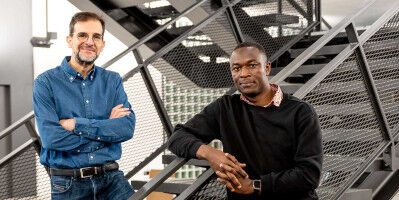
Vanessa Huxter, former member of Graham Fleming’s research group and now a at the University of Arizona, was a key member of the research team that provided unprecedented observations of ultrafast processes in diamond NV centers. (Photo by Beatriz Verdugo, University of Arizona)
From supersensitive detections of magnetic fields to quantum information processing, the key to a number of highly promising advanced technologies may lie in one of the most common defects in diamonds. Researchers at the Lawrence Berkeley National Laboratory (Berkeley Lab) and the University of California (UC) Berkeley have taken an important step towards unlocking this key with the first ever detailed look at critical ultrafast processes in these diamond defects. Using two-dimensional electronic spectroscopy on picoand femto-second time-scales, a research team led by Graham Fleming, Vice Chancellor for Research at UC Berkeley and faculty scientist with Berkeley Lab's Physical Biosciences Division, has recorded unprecedented observations of energy moving through the atom-sized diamond impurities known as nitrogen-vacancy (NV) centers. An NV center is created when two adjacent carbon atoms in a diamond crystal are replaced by a nitrogen atom and an empty gap. "Our use of 2D electronic spectroscopy allowed us to essentially map the flow of energy through the NV center in real time and observe critical quantum mechanical effects," Fleming says. "The results hold broad implications for magnetometry, quantum information, nanophotonics, sensing and ultrafast spectroscopy." Fleming is the corresponding author of a paper that describes this research entitled "Vibrational and electronic dynamics of nitrogen-vacancy centres in diamond revealed by two-dimensional ultrafast spectroscopy." The lead author is Vanessa Huxter, former member of Fleming's research group and now a professor at the University of Arizona.
TO READ THIS ARTICLE, CREATE YOUR ACCOUNT
And extend your reading, free of charge and with no commitment.