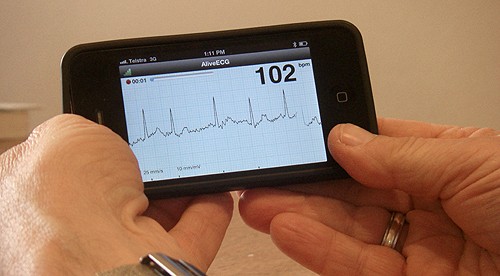
The iECG allows doctors to screen patients for atrial fibrillation, the most common heart rhythm problem, in minutes and treat them early, says Ben Freedman.
A special iPhone case and app can be used to quickly and cheaply detect heart rhythm problems and prevent strokes, according to University of Sydney research presented at the Australia and New Zealand Cardiac Society conference today on the Gold Coast. The research found the AliveCor Heart Monitor for iPhone (iECG) was a highly-effective, accurate and cost-effective way to screen patients to identify previously undiagnosed atrial fibrillation (AF) and hence help prevent strokes. What's more, the test is able to be used in local pharmacies and general practitioner surgeries with a single-lead ECG taken on an iPhone with a special case. Senior author, Professor Ben Freedman , said that the device was an exciting breakthrough and would greatly assist in the challenge to improve early identification of atrial fibrillation and prevention of stroke. "Atrial Fibrillation (AF) is the most common heart rhythm problem and is responsible for almost one third of all strokes," he said. "AF increases with age, affecting more than 15 percent of people aged 85 years and over. And people with atrial fibrillation face up to a five-fold increased risk of stroke, and tend to have more severe and life-threatening strokes.
TO READ THIS ARTICLE, CREATE YOUR ACCOUNT
And extend your reading, free of charge and with no commitment.