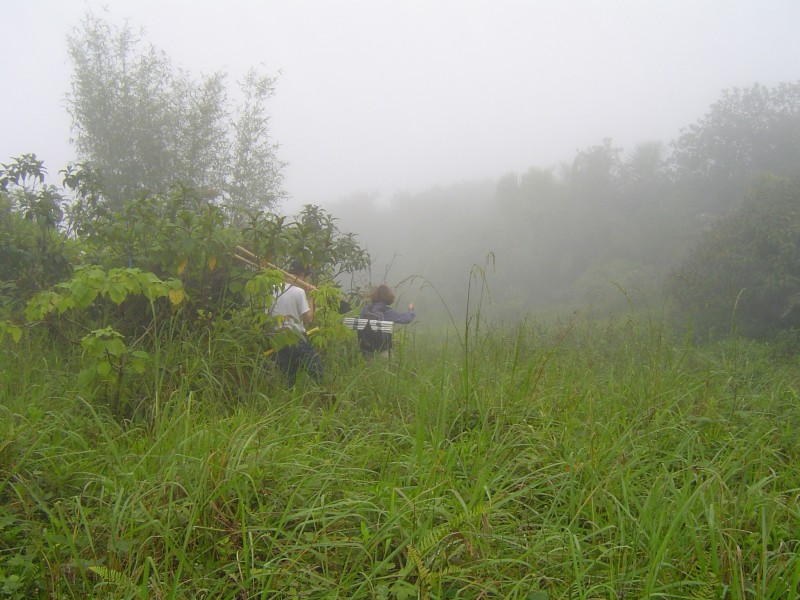
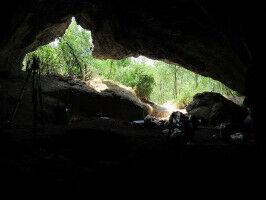
An expedition into the Luquillo Experimental Forest in Puerto Rico by JBEI and Berkeley Lab researchers led to the identification of a soil microbe that utilizes lignin as its sole source of carbon.
Nature designed lignin, the tough woody polymer in the walls of plant cells, to bind and protect the cellulose sugars that plants use for energy. For this reason, lignin is a major challenge for those who would extract those same plant sugars and use them to make advanced biofuels. As part of their search for economic ways to overcome the lignin challenge, researchers at the Joint BioEnergy Institute (JBEI) have characterized the enzymatic activity of a rain forest microbe that breaks down lignin essentially by breathing it. "Using a combination of transcriptomics and proteomics we observed the anaerobe Enterobacter lignolyticus SCF1 as it grows on lignin," says Blake Simmons, a chemical engineer who heads JBEI's Deconstruction Division. "We detected significant lignin degradation over time by absorbance, suggesting that enzymes in E. lignolyticus could be used to deconstruct lignin and improve biofuels production. Our results also demonstrate the value of a multi-omics approach for providing insight into the natural processes of bacterial lignin decomposition." Not only does lignin inhibit access to cellulose, the by-products of lignin degradation can also be toxic to microbes employed to ferment sugars into fuels. This makes finding microbes that can tolerate a lignin environment a priority for biofuels research.
TO READ THIS ARTICLE, CREATE YOUR ACCOUNT
And extend your reading, free of charge and with no commitment.