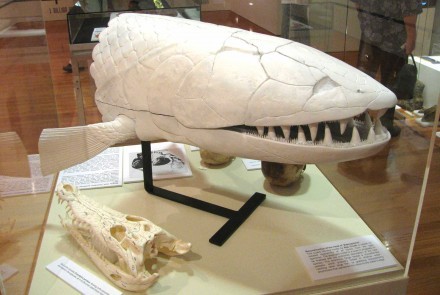
Three-dimensional life-size model of Edenopteron keithcrooki , built by Baz Crook, on display at the Canberra Museum and Gallery, December 2011. A crocodile skull is shown on the left for comparison.
Researchers from The Australian National University (ANU) working on the New South Wales south coast have discovered a new species of ancient fish, after unearthing the largest fossilised lobe-finned fish skull ever found in rocks of Devonian age. The descendants of these ancient fish evolved into the first land animals. Gavin Young from the Research School of Earth Sciences and his research team were excavating the skeleton of an extinct armoured fish from 360 million-year-old rock near Eden, NSW, when the bones they uncovered suggested there was more in the site than met the eye. "As we lifted out the block, we noticed a very large fang, at least 4 cm long," said Young. "Armoured fish don't have teeth, so we knew there must be a much larger predator also preserved at the site. "We uncovered an almost complete skull and shoulder girdle of an enormous lobe-finned fish, with jaws about 48 cm long." Preparing the fossil in the ANU laboratory took several years. "We used traditional methods of acid etching and casting, but also experimented with the latest surface scanning techniques to reconstruct the bones, and used the ANU high resolution CT scanner to investigate the internal structure of the teeth.
TO READ THIS ARTICLE, CREATE YOUR ACCOUNT
And extend your reading, free of charge and with no commitment.