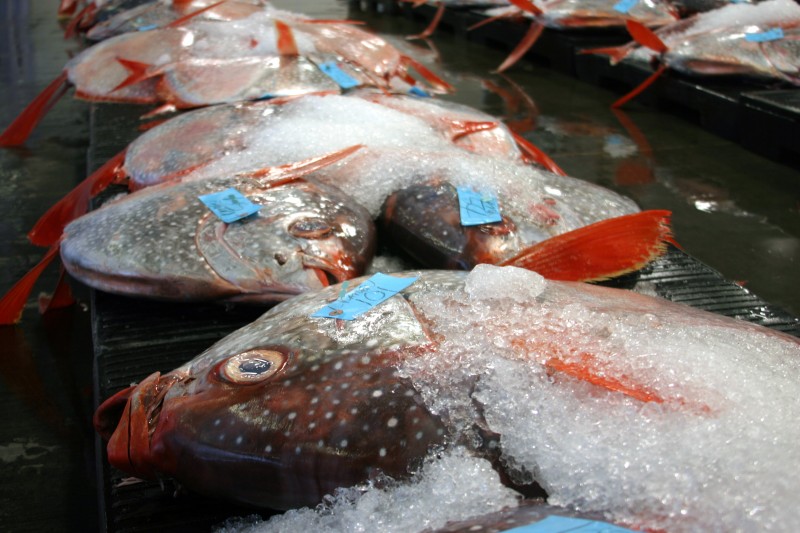
Opah, also called moonfish, at a fish auction in Hawaii. Opah were one of nine fish species analyzed in a new study that looked at how mercury gets into open-ocean fish and why the levels vary with depth. Image credit: C. Anela Choy
ANN ARBOR-University of Michigan researchers and their University of Hawaii colleagues say they've solved the longstanding mystery of how mercury gets into open-ocean fish, and their findings suggest that levels of the toxin in Pacific Ocean fish will likely rise in coming decades. Using isotopic measurement techniques developed at U-M, the researchers determined that up to 80 percent of the toxic form of mercury, called methylmercury, found in the tissues of deep-feeding North Pacific Ocean fish is produced deep in the ocean, most likely by bacteria clinging to sinking bits of organic matter. The study also confirmed that the mercury found in Pacific fish near Hawaii likely traveled through the air for thousands of miles before being deposited on the ocean surface in rainfall, said U-M environmental scientist Joel Blum. The North Pacific fisheries are downwind from rapidly industrializing nations such as China and India that are increasingly reliant on coal-burning power plants, a major source of mercury pollution. "This study reinforces the links between mercury emitted from Asian countries and the fish that we catch off Hawaii and consume in this country," said Blum, the lead author of a paper published online publication Aug. 25. "The implications are that if we're going to effectively reduce the mercury concentrations in open-ocean fish, we're going to have to reduce global emissions of mercury, including emissions from places like China and India," Blum said.
TO READ THIS ARTICLE, CREATE YOUR ACCOUNT
And extend your reading, free of charge and with no commitment.