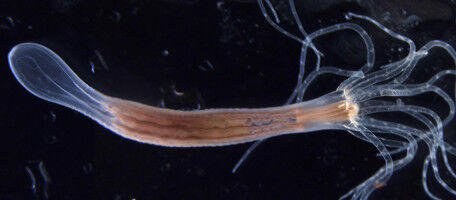
Phase contrast photomicrograph of a termite gut protozoan and attached symbiotic bacteria (small dark dots). Caltech researchers describe details of this association in the Sept. 16 edition of PNAS online.
When termites munch on wood, the small bits are delivered to feed a community of unique microbes living in their guts, and in a complex process involving multiple steps, these microbes turn the hard, fibrous material into a nutritious meal for the termite host. One key step uses hydrogen to convert carbon dioxide into organic carbon-a process called acetogenesis-but little is known about which gut bacteria play specific roles in the process. Utilizing a variety of experimental techniques, researchers from the California Institute of Technology (Caltech) have now discovered a previously unidentified bacterium-living on the surface of a larger microorganism in the termite gut-that may be responsible for most gut acetogenesis. "In the termite gut, you have several hundred different species of microbes that live within a millimeter of one another. We know certain microbes are present in the gut, and we know microbes are responsible for certain functions, but until now, we didn't have a good way of knowing which microbes are doing what," says Jared Leadbetter , professor of environmental microbiology at Caltech, in whose laboratory much of the research was performed. He is also an author of a paper about the work published the week of September 16 in the online issue of the Proceedings of the National Academy of Sciences ( PNAS ). Acetogenesis is the production of acetate (a source of nutrition for termites) from the carbon dioxide and hydrogen generated by gut protozoa as they break down decaying wood.
TO READ THIS ARTICLE, CREATE YOUR ACCOUNT
And extend your reading, free of charge and with no commitment.