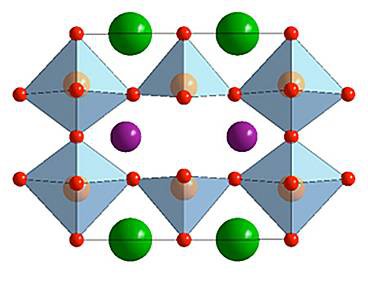
A diagram of the molecular structure of double perovskite shows how atoms of barium (green) and a lanthanide (purple) are arranged within a crystalline structure of cobalt (pink) and oxygen (red).
MIT researchers have found a new family of materials that provides the best-ever performance in a reaction called oxygen evolution, a key requirement for energy storage and delivery systems such as advanced fuel cells and lithium-air batteries. The materials, called double perovskites, are a variant of a mineral that exists in abundance in the Earth's crust. Their remarkable ability to promote oxygen evolution in a water-splitting reaction - which breaks water molecules into oxygen and hydrogen - is detailed in a paper appearing . The work was conducted by Yang Shao-Horn, the Gail E. Kendall Professor of Mechanical Engineering and Materials Science and Engineering; postdoc Alexis Grimaud; and six others. The performance of this family of materials, Shao-Horn says, is a step forward from the previous record-holder for a catalyst that promotes electrochemical water-splitting - a material that Shao-Horn and her team reported in a paper in Science two years ago. In addition, while the earlier material quickly changes structure during water-splitting, the new material is stable. Splitting water into its constituent elements could be a significant boon for renewable energy sources, such as wind and solar, whose output is highly variable.
TO READ THIS ARTICLE, CREATE YOUR ACCOUNT
And extend your reading, free of charge and with no commitment.