Bob Forties
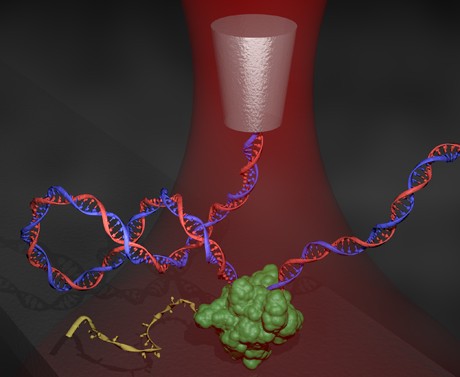
Like an impossibly twisted telephone cord, DNA, the molecule that encodes genetic information, also often finds itself twisted into coils. This twisting, called supercoiling, is caused by enzymes that travel along DNA's helical groove and exert force and torque as they move. For the first time, these tiny torques have been measured in the lab of Michelle Wang, professor of physics and Howard Hughes Medical Institute investigator. Using an instrument called an angular optical trap (AOT), Wang and colleagues have reported direct measurements of the torque generated by the motor protein, E. coli RNA polymerase (RNAP), as it traverses supercoiled DNA. Their technique may be used to examine the broader impacts of torque and DNA supercoiling associated with other motor proteins, and lend new insights into the gene transcription process. The work was published online June 27 , with first author Jie Ma, Cornell postdoctoral associate, and Lu Bai, former graduate student and now an assistant professor at Penn State. DNA supercoiling is an important regulator of gene expression, but it has been hard to study because of the minute torque involved, Wang said.
TO READ THIS ARTICLE, CREATE YOUR ACCOUNT
And extend your reading, free of charge and with no commitment.