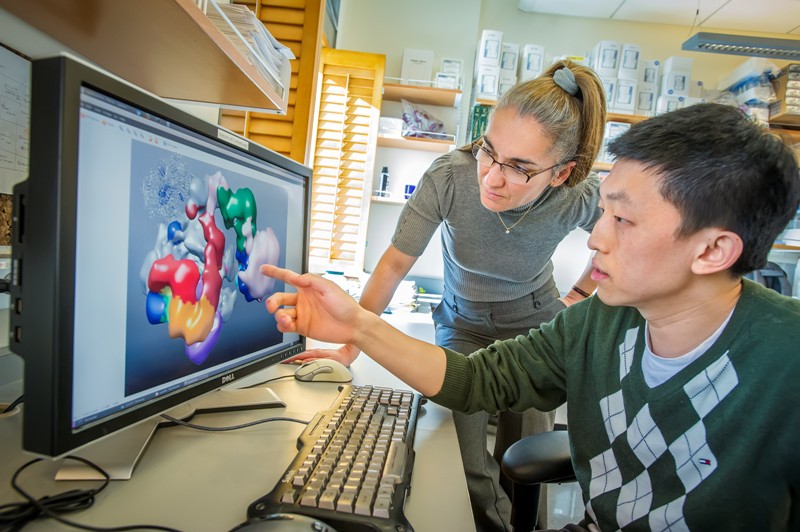
Eva Nogales and Yuan He used cryo-electron microscopy to record how a complex of biomolecules is able to read the human genome one gene at a time. (Photo by Roy Kaltschmidt)
Researchers with the U.S. Department of Energy (DOE)'s Lawrence Berkeley National Laboratory (Berkeley Lab) have achieved a major advance in understanding how genetic information is transcribed from DNA to RNA by providing the first step-by-step look at the biomolecular machinery that reads the human genome. "We've provided a series of snapshots that shows how the genome is read one gene at a time," says biophysicist Eva Nogales who led this research. "For the genetic code to be transcribed into messenger RNA, the DNA double helix has to be opened and the strand of gene sequences has to be properly positioned so that RNA polymerase, the enzyme that catalyzes transcription, knows where the gene starts. The electron microscopy images we produced show how this is done." Says Paula Flicker of the National Institutes of Health's National Institute of General Medical Sciences, which partly funded the research, "The process of transcription is essential to all living things so understanding how it initiates is enormously important. This work is a beautiful example of integrating multiple approaches to reveal the structure of a large molecular complex and provide insight into the molecular basis of a fundamental cellular process." Nogales, who holds joint appointments with Berkeley Lab, the University of California (UC) at Berkeley, and the Howard Hughes Medical Institute (HHMI), is the corresponding author of a paper describing this study in the journal Nature. The paper is titled "Structural visualization of key steps in human transcription initiation." Co-authors are Yuan He, Jie Fang and Dylan Taatjes.
TO READ THIS ARTICLE, CREATE YOUR ACCOUNT
And extend your reading, free of charge and with no commitment.