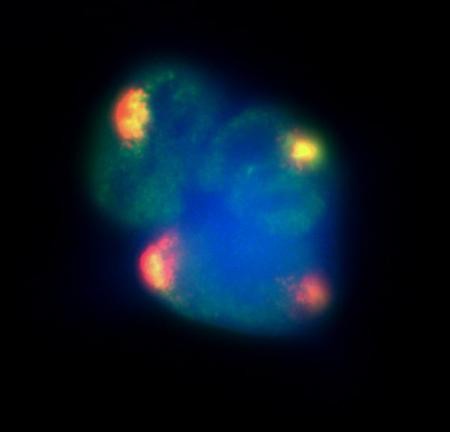
The Xist lncRNA (red) recruits proteins responsible for modifying chromatin architecture (green) across the X-chromosome. Xist and its associated proteins coat the entire X-chromosome, forming a distinctive compartment in the nucleus (blue).
The genes that code for proteins-more than 20,000 in total-make up only about 1 percent of the complete human genome. That entire thing-not just the genes, but also genetic junk and all the rest, is coiled and folded up in any number of ways within the nucleus of each of our cells. Think, then, of the challenge that a protein or other molecule, like RNA, faces when searching through that material to locate a target gene. Now a team of researchers led by newly arrived biologist Mitchell Guttman of the California Institute of Technology (Caltech) and Kathrin Plath of UCLA, has figured out how some RNA molecules take advantage of their position within the three-dimensional mishmash of genomic material to home in on targets. The research appears in the current issue of Science Express. The findings suggests a unique role for a class of RNAs, called lncRNAs, which Guttman and his colleagues at the Broad Institute of MIT and Harvard first characterized in 2009. Until then, these lncRNAs-short for long, noncoding RNAs and pronounced "link RNAs"-had been largely overlooked because they lie in between the genes that code for proteins.
TO READ THIS ARTICLE, CREATE YOUR ACCOUNT
And extend your reading, free of charge and with no commitment.