(Click for description)
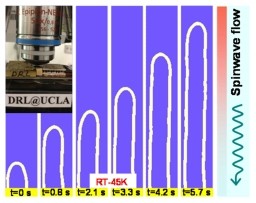
Imagine how much you could save on your electricity bill if you could use the excess heat your computer generates to actually power the machine. Researchers at the UCLA Henry Samueli School of Engineering and Applied Science have taken an important step toward harnessing that heat and converting it for practical use. The advance could lead to more energy-efficient appliances and information processing devices. The research team, led by Kang Wang, UCLA's Raytheon Professor of Electrical Engineering, demonstrates how to add power to a spintronics device, which uses the spin of electrons for energy rather than their charge. Excess heat, like that generated by extended use of a computer or other device, naturally creates what is known as a spin wave that can move a domain wall. A domain wall separates magnetic materials that point in different directions in certain magnetic devices. If housed within the central processing unit of a computer or other electrical device, a domain wall would serve as a sort of turbine, capturing the heat from the traveling spin wave and converting it into energy, just as a turbine harnesses the power of water and converts it into electrical energy that can be used to redirect the water or serve another purpose.
TO READ THIS ARTICLE, CREATE YOUR ACCOUNT
And extend your reading, free of charge and with no commitment.