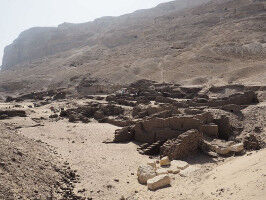
Researchers pinpoint when the first kings ruled Egypt
A team of scientists and archaeologists, including UCL's Professor David Wengrow and Dr Alice Stevenson, have been able to set a robust timeline for the first eight dynastic rulers of ancient Egypt. The study, which is published in the journal Proceedings of the Royal Society A, shows that Egypt formed far more rapidly than was previously thought and also updates the techniques first developed by Flinders Petrie over 100 years ago,. Having obtained over 100 fresh radiocarbon dates for hair, bone and plant samples excavated at several key sites, the team from UCL and University of Oxford were able to use mathematical modelling to combine the new radiocarbon dates with existing archaeological evidence to establish the chronology of Early Egypt between 4500 and 2800 BC and the likeliest date for each king's accession. Until now there have been no verifiable chronological records for this period or the process leading up to the formation of the Egyptian state, which occurred several centuries before the first pyramids were built. Instead scholars relied on archaeological evidence alone, using a method established by Flinders Petrie in which the evolving styles of ceramics excavated at human burial sites are used to piece together the timings of key chronological events in the Predynastic period and the First Dynasty. Dr Alice Stevenson, co-author of the study and curator of the UCL Petrie Museum, said: "Petrie was the first person to really apply a type of mathematical modelling to archaeology by developed the first example of what we now call 'seriation' in archaeology to create a relative dating - i.e. an ordering of material that is seen to be equivalent to a timescale.