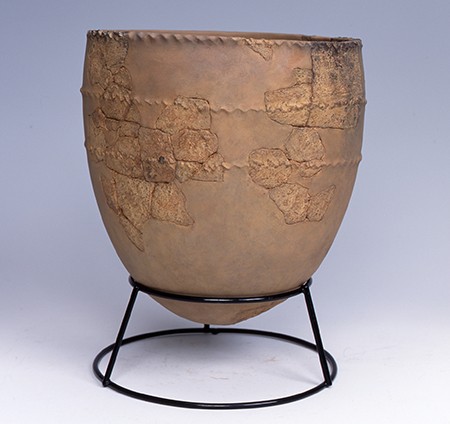
An Incipient Jomon pot from Kubodera-minami, Niigata Prefecture, Japan ca. 15,000 years old. Photo courtesy of Tokamchi City Museum
A study involving scientists at the University of Liverpool has found the earliest use of ceramic pots was for cooking fish. In the first study to address the question of why humans made pots, scientists from the UK, the Netherlands, Sweden and Japan carried out chemical analysis of food residues in pottery up to 15,000 years old from the late glacial period. Charred surface deposits The research team was able to determine the use of a range of hunter-gatherer "Jomon" ceramic vessels through chemical analysis of organic compounds extracted from charred surface deposits. The samples are some of the earliest found in Japan which is recognised to be one of the first centres for ceramic innovation, and date to the end of the Late Pleistocene - a time when humans were adjusting to changing climates and new environments. Until quite recently ceramic container technologies have been associated with the arrival of farming, but it is now known they were an adapted by hunter-gatherers much earlier, though the reasons for their emergence and subsequent widespread uptake are poorly understood. The first ceramic containers must have provided prehistoric hunter-gatherers with attractive new ways for processing and consuming foods but until now virtually nothing was known of how, or for what, early pots were used. "The carbon isotopes provided us with information on the biological and chemical origin of these fatty acids and we were able to confirm that the principle fats sorbed in the pottery were of aquatic rather than land origin" The researchers recovered diagnostic lipids from the charred surface deposits of the pottery.
TO READ THIS ARTICLE, CREATE YOUR ACCOUNT
And extend your reading, free of charge and with no commitment.