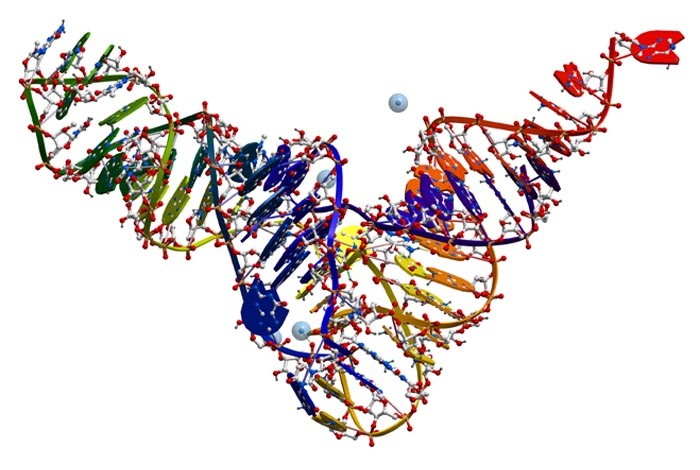
This molecular structure depicts a yeast transfer ribonucleic acid (tRNA), which carries a single amino acid to the ribosome during protein construction. A combined experimental and computational approach, to better understand signaling pathways that lead to genetic mutations, is at the core of this research.
Integrated biological and computational methods provide insight into why genes are activated. The combined, data-driven approach that includes validation allows researchers to systematically determine when models are too simple, too complex or just right - the "Goldilocks" approach. Many questions arise when two identical twins raised in the same home—fed the same, nurtured the same way—follow disparate paths. How can the identical offspring of a single egg turn out so differently? Scientists ask the same question when genetically identical cells in identical environments—monoclonal cells produced by a single ancestor that replicated—exhibit wildly different behaviors. Researchers say the changes may be due to random biochemical fluctuations known as stochasticity, or "noise”—variability occurring over time and influenced by environmental factors. Cells are highly sensitive to this noise, and minor fluctuations can lead to major changes, such as an Alzheimer's gene turning on or off or a cancer cell not responding to chemotheraphy. Are these random events due to chance or is there an undiscovered cause? The answer might be contained within nearly undetectable processes—the noise—at the molecular level, so researchers must peer into individual cells really, really closely without nudging and accidentally altering these sensitive cells and their processes. This is complicated in itself, there are so many cells—about 100 trillion in each human. All that can get lost in the noise, and even supercomputers cannot hope to capture all aspects of this incredible complexity. But experimental and computational scientists developed methods to sift through all the complexity and improve the illusive process of prediction with a simple model. Unraveling genetic stress reactions
TO READ THIS ARTICLE, CREATE YOUR ACCOUNT
And extend your reading, free of charge and with no commitment.