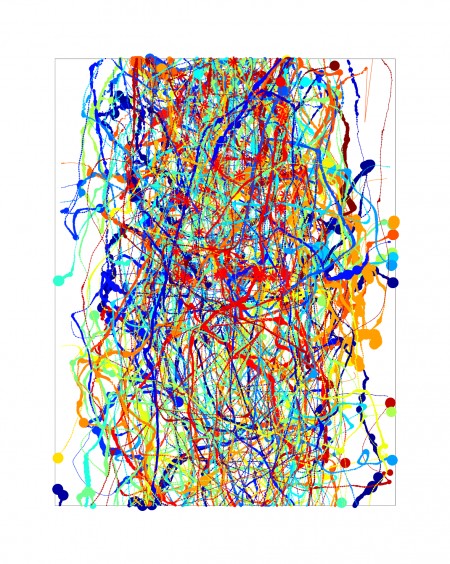
A tracing of the flies' flight trajectories as they explore in a wind tunnel, as seen from above. Each observation by the cameras is scaled according to flight speed, as if the animal was dribbling paint as it was flying; the longer the residence time, the larger the dot. Each trajectory is shown in a different color. The stars indicate when the flies were subjected to a brief gust of wind. These experiments revealed how the wind-sensing antennae stabilize the fly's visual flight controller.
Caltech researchers uncover a mechanism for how fruit flies regulate their flight speed, using both vision and wind-sensing information from their antennae. Due to its well-studied genome and small size, the humble fruit fly has been used as a model to study hundreds of human health issues ranging from Alzheimer's to obesity. However, Michael Dickinson, Esther M. and Abe M. Zarem Professor of Bioengineering at Caltech, is more interested in the flies themselves-and how such tiny insects are capable of something we humans can only dream of: autonomous flight. In a report on a recent study that combined bursts of air, digital video cameras, and a variety of software and sensors, Dickinson and his team explain a mechanism for the insect's "cruise control" in flight-revealing a relationship between a fly's vision and its wind-sensing antennae. The results were recently published in an early online edition of the Proceedings of the National Academy of Sciences . Inspired by a previous experiment from the 1980s, Dickinson's former graduate student Sawyer Fuller (PhD '11) wanted to learn more about how fruit flies maintain their speed in flight. "In the old study, the researchers simulated natural wind for flies in a wind tunnel and found that flies maintain the same groundspeed-even in a steady wind," Fuller says.
TO READ THIS ARTICLE, CREATE YOUR ACCOUNT
And extend your reading, free of charge and with no commitment.