Jason Koski/University Photography
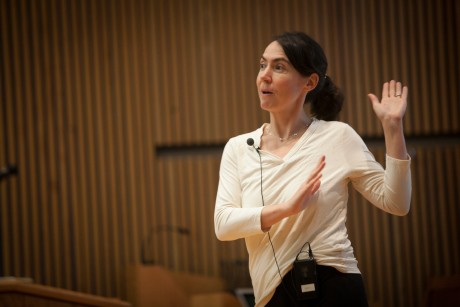
Rachel Bean shared some of the most recent discoveries about the history of the cosmos with a packed room of alumni June 7 during Reunion 2014. The associate professor of astronomy also talked about unresolved cosmic mysteries and encouraged young attendees to consider a career studying the heavens. Bean works in the field of cosmology, the study of how the universe began and evolved into what we see today, and much of her talk focused on the tools and theories scientists use to learn about the universe's origins. "Astronomy is a lot like cosmic archaeology," Bean said. "There are various archeological fossils or signals that we can see imprinted in the light of the universe." The earliest "fossils" of light from our universe that scientists have been able to detect, the cosmic microwave background, happened about 400,000 years after the Big Bang, or more than 13 billion years ago, Bean said. Scientists can study this period to find clues about even earlier days of the cosmos, Bean said. But the work is challenging. Although it's fairly easy to measure the light emitted by stars and galaxies, it's much more difficult to measure their distance from Earth, Bean said. And even after finding methods to measure distance, scientists have been puzzled trying to determine why the visible mass of stars is so much less than that galaxy's gravitational mass, which scientists calculate using formulas created by Newton and Einstein, Bean said. They wrestle with questions of what this missing "dark matter" might be and what it might say about how the universe is changing and expanding, she said. "Could it be black holes?
TO READ THIS ARTICLE, CREATE YOUR ACCOUNT
And extend your reading, free of charge and with no commitment.