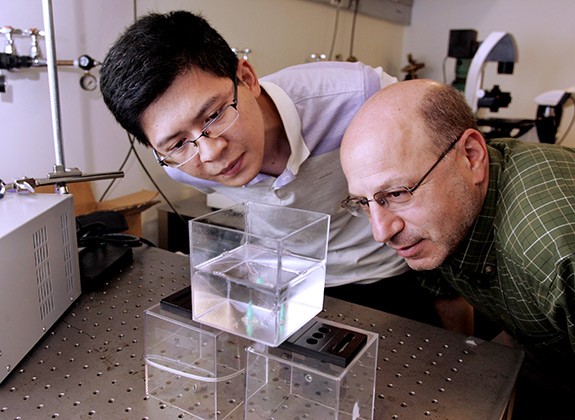
Princeton researchers have discovered that bursting bubbles can push tiny droplets of a surface material down into a base liquid as well as sending them into the air above. The finding has important implications for science and industries that are concerned with mixing liquid solutions. From right, Howard Stone, the Donald R. Dixon ’69 and Elizabeth W. Dixon of Mechanical and Aerospace Engineering, and graduate student Jie Feng observe bubbles in a tank. (Photos by Frank Wojciechowski for the Office of Engineering Communications)
Bubbling down: Discovery suggests surprising uses for common bubbles Posted August 19, 2014; 09:30 a.m. by John Sullivan, Office of Engineering Anyone who has ever had a glass of fizzy soda knows that bubbles can throw tiny particles into the air. But in a finding with wide industrial applications, Princeton researchers have demonstrated that the bursting bubbles push some particles down into the liquid as well. "It is well known that bursting bubbles produce aerosol droplets, so we were surprised, and fascinated, to discover that when we covered the water with oil, the same process injected tiny oil droplets into the water," said Howard Stone , the Donald R. Dixon '69 and Elizabeth W. Dixon Professor of Mechanical and Aerospace Engineering at Princeton and the lead researcher for the project. The conclusions provide new insight into the mixture of non-soluble liquids — a process at the center of many fields from drug manufacturing to oil spill cleanups. In an article published on July 13 in the scholarly , the researchers describe how they reached their conclusions after examining bubbles in containers holding water covered by a layer of oil. Using several experimental approaches, they presented a detailed physical description of how the bubbles burst and how that affected the oil and water mix. "If you look at this system, which has a thin layer of oil over water, the bursting bubbles were dispersing the oil phase in the form of nano-droplets into the water," said Jie Feng, a graduate student in Stone's lab and the lead author of the paper.
TO READ THIS ARTICLE, CREATE YOUR ACCOUNT
And extend your reading, free of charge and with no commitment.